
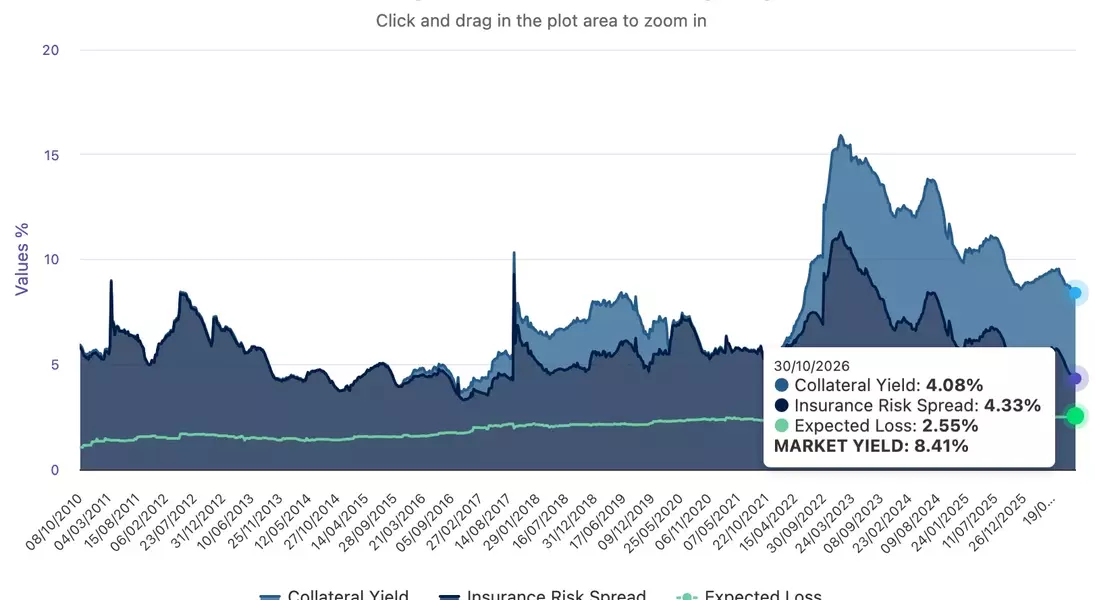
In a significant development for the financial markets, catastrophe bond insurance risk spreads experienced a continued decline throughout October 2026. This downward movement has pushed spreads to their lowest levels recorded since 2017, a trend largely influenced by seasonal market tightening. As this phase of contraction approaches its conclusion, observers are keen to understand the long-term implications of these reduced spreads on newly issued bonds and their overall impact on the market's yield trajectory.
Details of the Catastrophe Bond Market Analysis
During October 2026, data compiled by Plenum Investments revealed that the typical seasonal tightening, historically observed during hurricane seasons, persisted. Concurrently, an uptick in new bond issuances led to an increase in the catastrophe bond market's expected loss during the same month.
By the close of business on October 30th, the aggregated coupon yield for the catastrophe bond market had receded to 8.41%, a notable decrease from the 8.74% reported on September 25th. Furthermore, the insurance risk spread for the outstanding cat bond market registered at 4.33% as of October 30th, representing an approximate 13% reduction compared to the previous year.
Plenum Investments' historical records indicate that the last instance of such low cat bond market risk spreads was in August 2017. However, it's important to note that this followed a period where spreads had previously climbed from a low of 3.3% in November 2016.
The current overall cat bond market coupon yield of 8.41% reflects a roughly 4.5% decrease, which is less pronounced than the decline in insurance risk spreads alone. This discrepancy is partly attributable to the lower USD money market rates prevalent a year ago.
It is also worth noting that the market's expected loss, which stood at 2.25% on October 31st, 2025, increased to 2.55% by October 30th, 2026. This suggests that the current composition of outstanding catastrophe bonds entails a marginally higher risk profile.
Plenum Investments, commenting on the October report, highlighted that total returns in the CAT bond market exhibited variations across different currencies. Returns ranged from 8.4% in USD (down from 8.7% the prior month), to 7.0% in EUR (down from 7.2%), and 4.2% in CHF (down from 4.5%). The firm noted that spread tightening continued, with an additional 5% reduction in October. However, the pace of this tightening is decelerating, aligning with expectations as the hurricane season draws to a close. This more moderate tightening trend is anticipated to extend into November, with a subsequent expectation for spreads to begin widening again in December.
While seasonal factors influence the insurance risk spread, the average spread across all existing deals also plays a crucial role. Consequently, newer issuances will increasingly become visible in market data. This is already evident in the rising expected loss of the cat bond market over recent weeks, although maturities also contribute to this metric as the market's composition evolves. With a robust pipeline of cat bond issuances anticipated in the fourth quarter, greater clarity on the impact of new bonds on market metrics is expected in the coming months.
Furthermore, the contribution of the risk-free return on collateral significantly bolsters the overall coupon yields for the cat bond market. For instance, when risk spreads bottomed out in 2016, the total yield for investors was around 3.70%. In contrast, the collateral yield alone currently stands at 4.08%, which, when combined with the 4.33% risk spread, results in the present total coupon return of 8.41%.
Considering the catastrophe bond market's return in excess of expected loss, currently at 5.86% as of October 30th (down from 6.24% on September 25th), a comparison with the 2016 soft reinsurance market reveals a stark difference. During that period, despite lower expected losses, the cat bond market yield over expected loss was less than 2%. This historical perspective underscores that, comparatively, current spreads and yields in the catastrophe bond market are considerably higher than those observed during the previous soft reinsurance market cycle.
The consistent appeal of catastrophe bonds as a valuable diversifier and a source of relatively uncorrelated returns for investment portfolios explains the sustained robust investor appetite, even in the face of declining pricing.
The recent dip in catastrophe bond risk spreads, reaching their lowest point since 2017, presents a multifaceted picture for investors and market analysts. On one hand, it signals a period of intensified market tightening, which could offer attractive entry points for some investors seeking diversified portfolios. On the other hand, the impending end of this tightening phase and the potential for widening spreads introduce an element of uncertainty. The crucial takeaway is the resilience and comparative strength of the cat bond market today versus previous soft market cycles, primarily driven by higher collateral yields and continued investor demand for uncorrelated returns. This suggests a maturing market that, despite fluctuations, remains a significant component of risk transfer and investment strategies.